
One of the most common questions we get at HairBridge UK is simple: "What will I actually look like afterwards?" It's a fair question. The internet is full of polished marketing photos, but very few resources give you an honest, month-by-month picture of what hair transplant results genuinely look like — the good, the temporary setbacks, and the final outcome.
This guide is our attempt to change that. Below you'll find a realistic timeline of hair transplant before and after progress, an explanation of what drives results, and real photos from our partner clinic in Istanbul — the same clinic whose lead surgeon has completed over 21,000 procedures.
The Full Hair Transplant Results Timeline
The most important thing to understand is that a hair transplant is not an instant fix. The final result takes a full year to appear. Here is what to expect at every stage.
Your scalp will look red and slightly swollen. Tiny scabs will form around each implanted graft — this is completely normal and is the scalp beginning to heal. You'll be given a detailed aftercare kit and washing instructions. Most patients describe mild discomfort rather than pain. You will not look like yourself yet, but you are not supposed to.
Around two to three weeks after your procedure, the transplanted hairs will begin to shed. This is called shock loss, and it alarms almost every patient who isn't warned about it in advance. It is entirely normal. The hair shaft falls out, but the follicle — which is what was transplanted — remains alive beneath the surface. The shedding is temporary. New growth will follow.
This is the phase that tests patience. Little visible change occurs on the surface, but beneath the scalp, transplanted follicles are anchoring and preparing to enter a new growth cycle. The donor area at the back of the head will also continue healing during this period. Most redness will have cleared by the end of month two.
This is when most patients feel their first real optimism. Fine, thin hairs begin emerging from the transplanted follicles. The hair is wispy and may appear uneven at first — this is normal. Not all follicles begin growing at exactly the same rate. By month four, coverage is starting to become visible and most patients can style their hair to conceal the work-in-progress.
At the six-month mark, the majority of transplanted follicles are actively growing. Density is improving week on week. This is often the point at which patients start receiving comments from friends and family. The hair remains slightly finer than fully mature hair, but the transformation is clearly visible. Many before and after photos shared online are taken at six months — the results are real, but not yet final.
Between nine and twelve months, transplanted hairs reach their full thickness and mature density. The hairline is defined, coverage is consistent, and the result should be indistinguishable from natural hair. For patients with larger procedures or finer hair types, some additional maturation can occur up to 18 months. But for most patients, month 12 is the moment the full result is visible.
Real Before and After Photos
The following images are from real patients treated at our partner clinic in Istanbul. No filters, no selective lighting — just honest documentation of results.
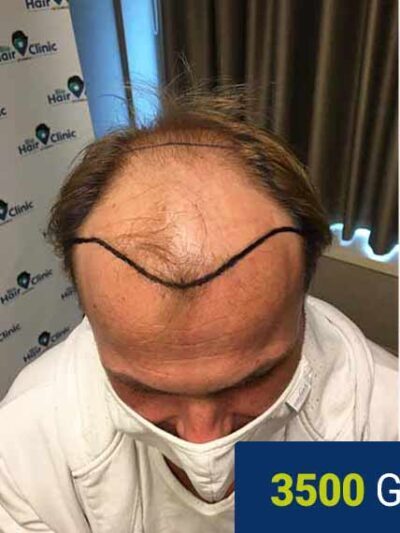


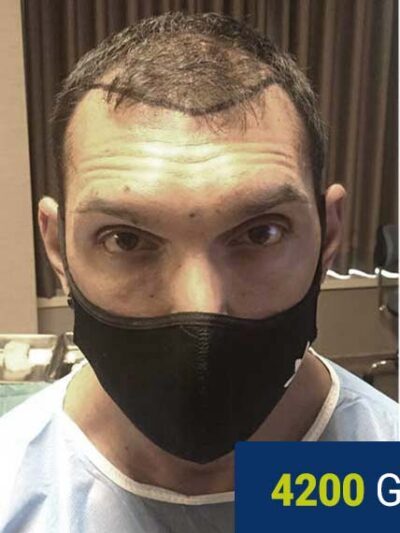

Our partner clinic in Istanbul has performed over 21,000 procedures. The consistency of results at this volume isn't luck — it's the product of a surgical team that has refined every element of the process over thousands of cases.
How Many Grafts Do You Actually Need?
Graft count is one of the most misunderstood aspects of hair transplant planning. More is not always better — the right number depends entirely on your pattern of loss, your donor density, and the coverage goal you're aiming for.
| Area Being Treated | Approximate Graft Range |
|---|---|
| Hairline only (frontal zone) | 1,500 – 2,500 grafts |
| Hairline and mid-scalp | 2,500 – 3,500 grafts |
| Crown (vertex) only | 1,500 – 2,500 grafts |
| Hairline, mid-scalp, and crown | 3,500 – 5,000 grafts |
| Full restoration (advanced loss) | 5,000 – 6,000+ grafts |
| Temple points or beard/eyebrow | 300 – 800 grafts |
These ranges are a guide only. Your actual graft count will be assessed during your free consultation with HairBridge UK, where we review photos of your current hair loss and connect you with the clinic's surgical team for a proper evaluation. We never recommend a procedure until the clinical team has confirmed you're a suitable candidate.
What Affects Your Hair Transplant Results?
Two patients can receive the same number of grafts at the same clinic and achieve different levels of density. These are the key factors that influence your outcome.
Donor Hair Quality and Density
The hair at the back and sides of the scalp — the donor area — is genetically resistant to the DHT hormone that causes male pattern baldness. But donor density varies between individuals. Those with thick, coarse hair and a dense donor zone will generally achieve fuller-looking results than those with finer hair, even with an equivalent graft count. A thorough pre-procedure assessment of your donor area is essential, and it's a core part of the planning process at our partner clinic.
Extent of Hair Loss at the Time of Procedure
The earlier a hair transplant is performed, the more donor hair remains available and the less area needs to be covered. Patients in the earlier stages of loss (Norwood Scale 2–4) typically achieve excellent coverage with a single session. Those with more advanced loss may need larger sessions or staged procedures over time.
The Technique Used — FUE, DHI, or Sapphire FUE
The extraction and implantation method affects both the naturalness of the hairline and the survival rate of grafts. At our partner clinic, the three main techniques used are FUE (Follicular Unit Extraction), DHI (Direct Hair Implantation), and Sapphire FUE. Each has specific advantages depending on the area being treated and the patient's goals. Read our full comparison in FUE vs DHI vs Sapphire: Which Is Right for You?
Aftercare Compliance
Graft survival in the first ten days is strongly influenced by how carefully you follow aftercare instructions. Sleeping position, washing technique, sun exposure, and avoiding physical strain all play a role. Our complete aftercare guide walks through every stage in detail. This is an area where having UK-based support through HairBridge matters — you can reach us directly if something looks or feels unusual in the days after your procedure.
Surgeon Experience
The angle, depth, and direction at which each graft is implanted determines whether the result looks natural or artificial. This is a skill that develops over thousands of procedures — not hundreds. As we explore in our article on what 21,000 procedures means in practice, the volume of experience at our partner clinic is a significant part of why results are consistently strong.
Donor Area Recovery — What to Expect
A common concern is whether the donor area — where grafts are harvested from the back of the scalp — will look obviously thin after the procedure. With modern FUE technique, individual follicular units are extracted one by one rather than removed as a strip, leaving no linear scar.
In the first week, the donor area will appear shaved and may have small red dots at each extraction site. These resolve within ten to fourteen days. Within four to six weeks, hair in the donor zone has regrown sufficiently to be undetectable at normal hair lengths. The donor area is not permanently depleted — the remaining follicles continue growing normally, and the extracted zones fill in visually as surrounding hair grows.
Managing Expectations: What a Hair Transplant Can and Cannot Do
A hair transplant moves your own hair from areas of permanence to areas of loss. It does not create new hair, and it does not stop ongoing hair loss in non-transplanted areas. For patients with progressive loss, a maintenance plan — which may include medication such as finasteride or minoxidil — is often recommended alongside the transplant to protect existing hair.
At HairBridge UK, we are transparent about this from the first conversation. We would rather you understand exactly what to expect and proceed with confidence than feel surprised or disappointed at any stage.
What a well-executed hair transplant can do is remarkable: restore a natural hairline, add density to thinning areas, and produce results that are genuinely indistinguishable from natural hair growth. The before and after photos above are not outliers — they are representative of what patients consistently achieve at our partner clinic.
Why UK Patients Choose Istanbul for Their Hair Transplant
The majority of hair transplant Turkey results we see are produced by clinics in Istanbul — and for good reason. The city has become the global centre for hair restoration, with surgeons who perform procedures daily rather than a few times per week. The cost difference compared to UK clinics is substantial, and the all-inclusive packages — hotel, transfers, aftercare kit — make the logistics straightforward.
What HairBridge UK adds to that is a UK-based layer of support: a team you can call or message before, during, and after your procedure, who have personally visited the clinic and know the team. If you're wondering why so many UK patients are making this choice, our article Why Thousands of UK Patients Choose Istanbul for Hair Transplants covers the full picture, including a detailed cost comparison.
You can also read honest accounts from patients who have made the journey in UK Patients, Real Results.
Ready to see what's possible for your hair?
Send us a few photos and we'll give you an honest, no-obligation assessment — including an estimated graft count and what your results could look like.
Get Your Free Consultation